Process Discovery
Part of Process mining and operational evidence
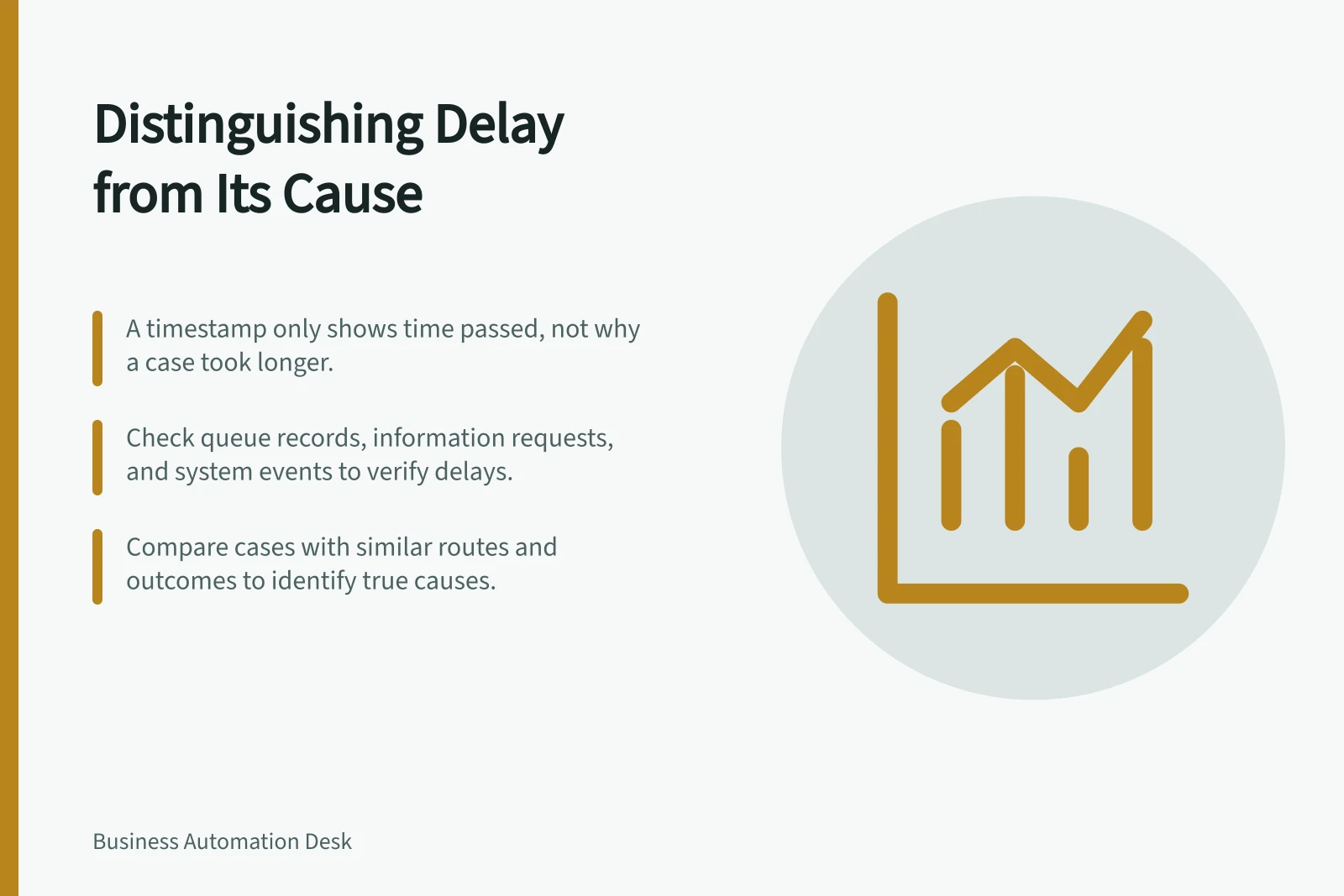
Distinguishing observed delay from its underlying cause
Learn what a long gap in a process log establishes and how to check possible causes against case records.
A long interval between two logged events establishes only that time passed between those records. It does not show a team was idle, nor why the case took longer. To investigate a cause, verify what the timestamps mean, compare similar cases and inspect evidence from the interval.
State the observation
Name the start and end events, case population, reporting calendar and period covered. If assignment was recorded on Monday and approval on Thursday, the measure is the time between those events. It may contain queuing, active review, a wait for information, parallel work or a late status update.
Check time zones, missing events and changes in system behaviour. A timestamp may mark when a status was saved rather than when work began. Reliable activity start and end data can support an activity-duration measure; a single event timestamp cannot supply it by itself.
Show the number of cases, a typical duration and the slower cases. Segment by route, request type and outcome where useful. Keep cases still open visible rather than calculating only from those that finished. Compare periods with different case mixes cautiously.
Check competing explanations
For a delayed approval, possible explanations include an unavailable approver, incomplete submission, scheduled waiting period, system outage or missing event. Each needs different evidence:
Possible explanation / Evidence to seek
- Waiting in an owner's queue
- Assignment and acceptance records, queue state and owner account
- Awaiting information
- Information request, response and the case's held state
- Longer active review
- Work start and finish evidence or a bounded handling-time observation
- Recording artefact
- Source record and system-event timing
These are prompts, not findings about an organisation. Ask people who handled selected cases what happened and compare their account with case records. Include an ordinary case and cases at both ends of the duration range.
A tool may find that an attribute is associated with longer durations. That association can help select cases to inspect. It does not prove the attribute caused the delay: other factors may differ, and relevant actions may be missing from the extract.
Possible Explanations for Delayed Approval and Supporting Evidence
- Waiting in an owner's queue
- Assignment and acceptance records, queue state, owner account activity
- Awaiting information
- Information request and response logs, case held status
- Longer active review
- Work start and finish timestamps, bounded handling-time observation
- Recording artefact
- Source record, system-event timing analysis
Assess a proposed explanation
Write a narrow hypothesis, such as: 'Missing-information waits explain the measured interval for this route.' Check for recorded requests and replies, look for the pattern in comparable cases and seek contrary cases. If the evidence remains incomplete, report the measured interval and the unresolved explanation separately.
Choose a response only after that review. If the team changes an intake field or escalation route, measure later cases using the same event definitions and check correctness and returned work alongside speed.
Steps to Assess a Proposed Explanation for Process Delay
- Formulate a narrow hypothesise.g., 'Missing-information waits explain the measured interval for this route.'
- Check for recorded requests and repliesReview case logs for communication trails and status updates
- Look for patterns in comparable casesCompare similar cases across routes, request types and outcomes
- Seek contrary casesIdentify exceptions where delay occurred without the proposed cause
- Report unresolved explanations separatelyIf evidence is incomplete, maintain transparency about uncertainty