Human Oversight
Part of Automation governance
Assigning a business owner and a technical owner
Define the business and technical owners’ decisions, handoffs, deputies and escalation route for a live automation.
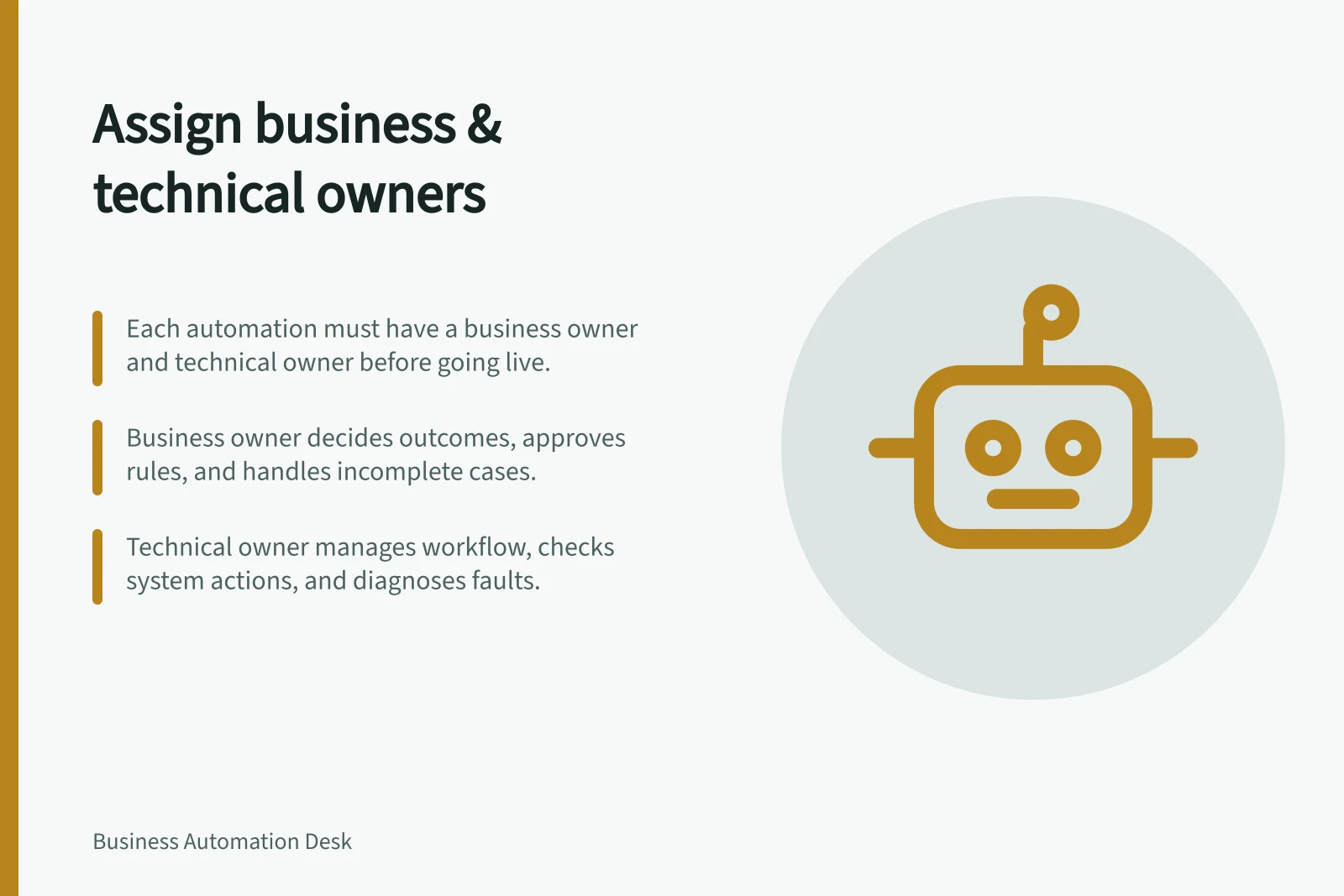
Give each live automation a business owner who can decide whether it should act, and a technical owner who can explain how it acts and whether it ran as intended. Record both roles, their deputies and their decision rights before production use.
Assign the result and the mechanism
The business owner represents the team accountable for the process outcome. They define eligible cases, approve the business rule and decide what to do when the rule cannot finish a case.
Choose a role with authority over the process, rather than assuming the person who requested the automation can make those decisions.
The technical owner manages the implemented workflow: connections, permissions, versions, monitoring, fault diagnosis and deployment. They should know how to check the intended action in the destination system.
Access to an editable setting does not give them authority to change a business decision.
| Decision | Business owner | Technical owner |
|---|---|---|
| Change an eligibility rule | Approves its meaning and affected cases | Assesses and implements the approved version |
| Resolve an ambiguous case | Makes or assigns the authorised decision | Supplies system evidence and holds execution where needed |
| Respond to a failed run | Sets business priority and permitted fallback | Establishes technical state and recovery options |
| Resume after a material stop | Accepts the treatment of affected cases | Confirms system readiness |
Other authorities may be needed. Record when privacy, security, finance or application owners must approve a change. The two named owners do not replace those decisions.
Make the handoff usable
For each automation, record its stable ID, purpose, intended business result, both owners, deputies, contact and escalation routes, and where its current rule is held. Agree on what counts as completed work and where an uncertain result waits.
Consider a hypothetical approved request sent to another system before the response times out. The technical owner checks whether the destination record exists. The business owner decides the route for a confirmed incomplete or unresolved request. Neither can infer from the timeout that nothing happened.
Key Handoff Requirements for Automation
- Stable ID of automationRecorded
- Purpose and intended business resultDocumented
- Both owners and deputiesIdentified and recorded
- Contact and escalation routesAgreed and documented
- Location of current ruleClearly stored and accessible
- Definition of completed workAgreed upon
- Process for uncertain resultsDefined and communicated
Handle shared teams and vacancies
If several departments benefit, assign one accountable business owner for the defined result. Other teams can still own their decisions within the process. A committee can advise, but an urgent case needs someone able to make a timely call.
When an owner leaves the role, transfer the current rule, open exceptions, recent changes and recovery instructions before removing their access. Appoint an interim owner if needed.
In a small team where one person fills both roles, keep the two decisions distinct and seek another authorised reviewer for consequential changes.
Recheck the assignment after a restructure, supplier handover or major system change. It works when both owners can explain a case, decide within their authority and be reached when the automation needs attention.
Handling Vacancies and Team Transitions
- When an owner leavesTransfer current rule, open exceptions, recent changes and recovery instructions before access removal
- Interim appointmentAppoint an interim owner if required
- Single person in dual roleKeep decisions distinct; seek another authorised reviewer for consequential changes
- Post-restructure reviewRecheck assignments after restructure, supplier handover or major system change