Quality Assurance
Part of Finance process automation
Reviewing finance automations with responsible specialists
Finance automation needs periodic review by people who understand accounting, operations and system behaviour.
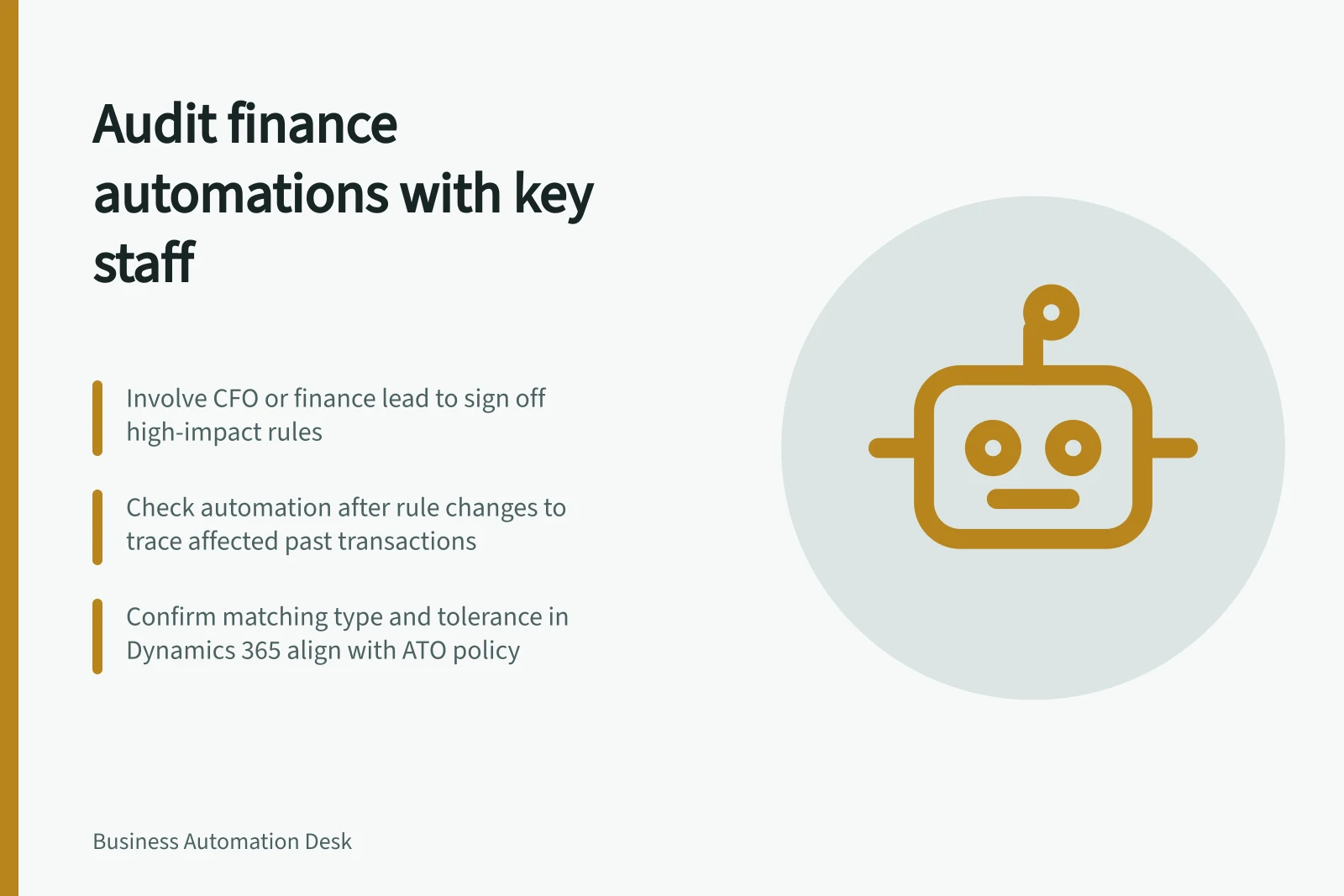
Review finance automation to check that configured rules, data and outcomes still align with policy. Involve the CFO or finance lead to confirm policy and sign off high-impact rules, finance professionals to assess accounting outcomes, IT colleagues to trace system behaviour, and operations staff to explain process hand-offs.
Review when supplier rules, approval authority or tax treatment changes, and when overrides or reconciliation differences appear. Also check the automation after a rule change, so you can identify affected past transactions before changing the rule again.
Bring a standard transaction, several recent exceptions, an override, a duplicate warning and a reconciliation difference. For accounts payable matching, compare the vendor invoice with the purchase order and product receipt, then check which matching type and tolerance applied.
Microsoft Dynamics 365 Finance supports invoice totals matching, two-way price matching, three-way price and quantity matching, and charges matching. Confirm that the configured type and tolerance still reflect the legal entity’s policy; differences beyond the specified tolerance produce match variance icons.
Use a concrete tolerance test where relevant: a purchase order price of 1.00 and an invoice price of 1.10 exceed a 5 per cent net unit price tolerance, while 1.05 is acceptable. Check the decision against the invoice, purchase order, product receipt, configured tolerance and matching details.
For each case, record the rule that produced the result, the expected and actual outcome, and the evidence reviewed. In Dynamics 365 Finance, inspect the Vendor invoice page and the Invoice history and matching details page for matching variance icons; also check the configured vendor invoice workflow and whether imported invoices are submitted automatically. Manually entered invoices must be submitted manually.
Separate a system fault from a policy disagreement. If staff repeatedly override a valid control, investigate workflow friction or a missing exception path; if a rule is wrong, identify affected past transactions before changing it.
Keep the review record with an owner, date, change rationale and approval for each adjustment. Have the CFO or finance lead sign off high-impact financial rules, and confirm that automated posting and payment remain reconciled to the source records.
Matching Types in Microsoft Dynamics 365 Finance
- Invoice Totals MatchingCompares total invoice amount with purchase order total; no line-level detail.
- Two-Way Price MatchingMatches invoice price per unit with purchase order price; ignores receipt quantity.
- Three-Way Price and Quantity MatchingMatches invoice price and quantity with both purchase order and product receipt.
- Charges MatchingMatches additional charges (e.g., freight, handling) on the invoice with those in the purchase order.
Key Review Indicators for Finance Automation
- Tolerance Test Example: 5% Net Unit PricePO price $1.00 → Invoice price $1.10 = Over tolerance (10%); $1.05 = Within tolerance
- Automated Invoice SubmissionOnly imported invoices can be submitted automatically; manually entered ones require manual submission.
- Match Variance IconAppears when differences exceed configured tolerance; visible on Vendor invoice and Invoice history pages.