Process Discovery
Part of Procurement process automation
Routing a purchase request by value and category
Design purchase-request approval rules using value and category, then check mixed requests, boundary cases and material edits.
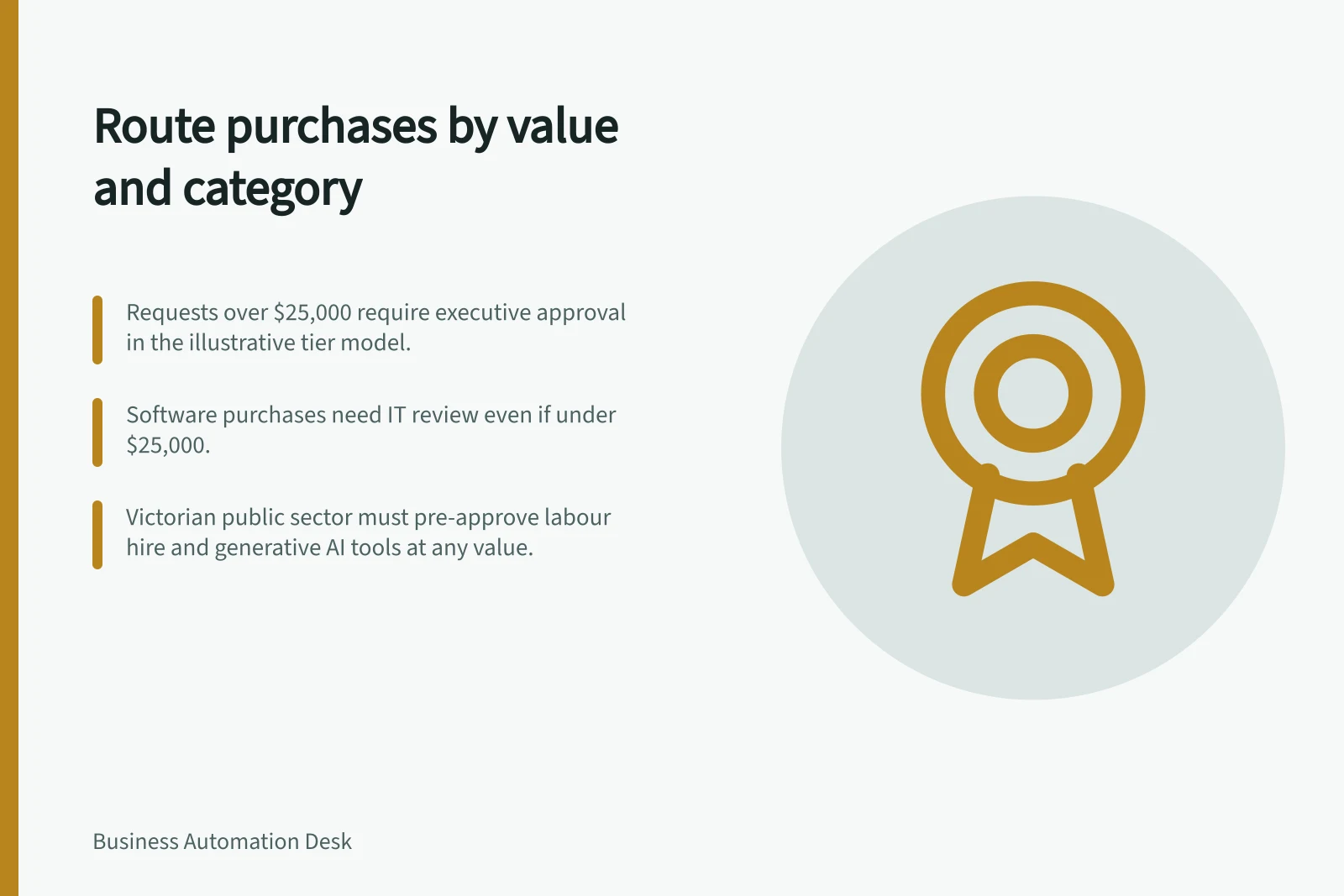
Value determines the financial approval level; category can add a specialist review. One illustrative tier model sends requests up to $5,000 to department-level approval, requests from $5,001 to $25,000 to a procurement manager, and requests above $25,000 to executive approval. Under those bands, an $18,000 request goes to a procurement manager; if it is for software, add IT review.
Set the actual limits and authorised roles under the organisation’s authority rules. A request may need both financial approval and a category-specific decision.
Establish the inputs
Capture description, category, quantity, estimated total, currency, cost centre and requester. Define whether an approval limit applies to a line, the whole request or a wider commitment. Use the anticipated total as the value basis and state whether delivery and ongoing costs count when the limit is based on the full commitment. A request should not avoid a limit merely because its lines are individually smaller.
Record value limits and role alignment in the Delegation of Authority (Procurement) and Procurement Approval Matrix. Make the applicable value basis clear in the local rule; the authority limit must be assessed on the basis that rule specifies.
Keep category labels clear enough to route work; a broad label such as 'services' can conceal different review needs. Assign an owner for unclear classifications. For a mixed-category request, decide whether all relevant specialists should review it or whether separate requests are justified. Splitting must not be used to avoid approval.
Build the route
| Question | Possible action | Decision to record |
|---|---|---|
| Is essential information missing? | Return the request for correction | What is needed before routing |
| Which value band covers the commitment? | Send to the authorised financial delegate | Approval for that value |
| Does the category require specialist review? | Send to the relevant specialist | Suitability or risk decision |
| Is the supplier new or outside an arrangement? | Send to the supplier or procurement owner | Checks and buying route required |
| Has a material field changed? | Recalculate affected approvals | Which earlier decisions remain valid |
Map each value band to an authorised role. An illustrative model uses department-level approval up to $5,000, procurement manager approval from $5,001 to $25,000, and executive approval above $25,000; another example routes an $18,000 request to a procurement manager. These are examples, not authority limits for every organisation.
Category rules add conditional reviewers: software can go to IT, and contracts to legal. For example, an $18,000 software request under the illustrative bands goes to a procurement manager for value approval and to IT for category review. The budget owner is accountable for the money; add that approval where the local authority rules require it.
For Victorian public sector bodies and entities, relevant requirements for generative AI tools and labour hire apply at any value. The relevant AI guideline makes entities responsible for approving official-use AI software procurement; the labour-hire guidelines include pre-approval requirements.
Approval rules can use factors such as total cost, category or whether an item is non-catalogue, and can require decisions in sequence or in parallel. Define any watcher role separately: receiving information does not itself grant approval authority.
Check conflicts and changes
Review sample requests on both sides of each local value boundary, plus mixed and unknown categories and an unavailable approver. Confirm who is authorised for each decision and what locally authorised substitute applies when an approver is unavailable. If two rules apply, retain both decisions unless policy explicitly combines them.
Treat a higher amount, changed category or different supplier after approval as a potential material change: define which of these requires recalculation or resubmission, and retain the earlier approval in the history. A spelling correction may need different treatment.
After rollout, review manual reassignments: repeated changes can reveal stale ownership data or a rule that no longer fits purchasing practice.