Human Oversight
Part of Procurement process automation
Handling a purchase outside the normal rules
Record and route procurement exceptions with the right authority, clear conditions and a truthful decision history.
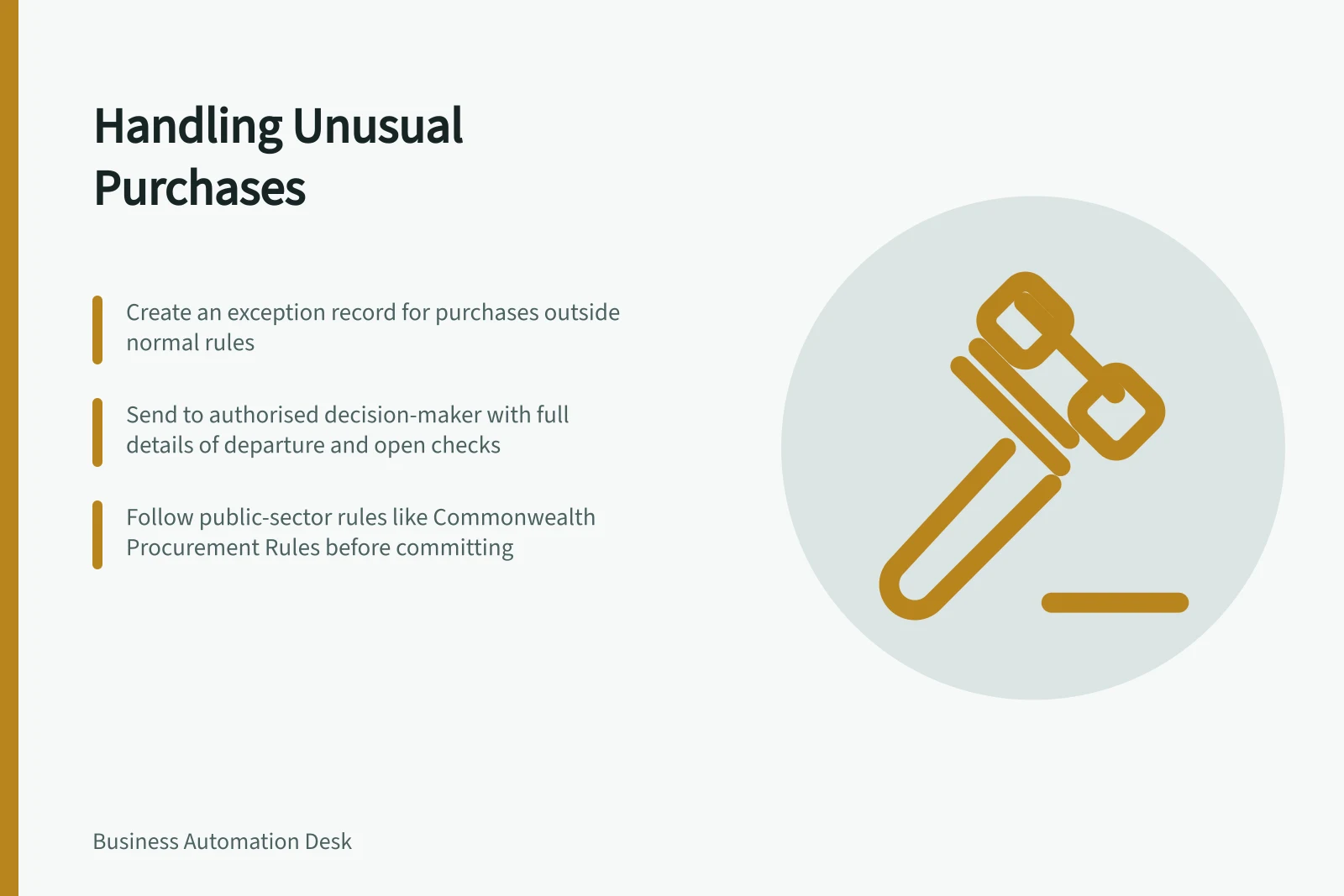
When a purchase cannot follow the usual route, create an exception record and send it to the person authorised to decide. State the rule affected, why the usual path cannot be followed and which checks remain open. Urgency can require a prompt decision; it does not itself authorise a commitment.
Identify the departure
A genuinely urgent need differs from a late request. A supplier that is the only feasible source differs from one chosen for convenience. If someone has already committed to buy, record the real sequence rather than backdating an approval.
Capture the request, requirement, value, category, supplier, deadline and ordinary route. Specify the departure, such as missing competition, an unapproved supplier, an exceeded limit or unavailable evidence. Record alternatives considered and why they were unsuitable.
Urgent need vs. late request: key differences
- Genuinely urgent need
- Threat to operations, time-sensitive delivery, no alternative supplier available.
- Late request
- Poor planning, missed deadlines, avoidable delay in initiating procurement.
Assign each decision
Send the case to the authority named in the organisation’s policy. Procurement may assess the buying method, a financial delegate may authorise the commitment and a specialist may assess a technical or security issue. Record each decision separately.
Possible outcomes include approval for a stated scope, a request for more information, refusal or containment pending review.
An approval should state any limit, permitted supplier and conditions.
If a supplier check is incomplete, specify whether work may continue only as investigation or whether an order may be issued. Keep later changes as new events in the record.
Check public-sector rules where applicable
The Commonwealth Procurement Rules are a Department of Finance publication. For a Commonwealth purchase, check the current rules and seek procurement or legal advice before commitment.
Do not assume a departure is permitted; have the applicable rules assessed before commitment.
Those Commonwealth rules are not a universal exception route. State, territory and private-sector buyers must follow their own applicable rules and approval instruments. The responsible procurement or legal specialist should assess whether a particular exemption or limited-tender condition applies before commitment.
Pros and cons of deviating from standard procurement
- ProsEnables rapid response to emergencies; avoids operational disruption; supports critical service delivery.
- ConsIncreases risk of non-compliance; may lead to overpayment or poor quality; undermines transparency and accountability.
Close the case truthfully
Update the purchase record with the decision and outstanding actions. If the commitment happened first, retain when it occurred, who made it, when it was discovered and how the organisation responded. A later decision must not make the record appear to show prior approval.
Review recurring exceptions by reason and owner. Frequent urgent requests may reveal a planning issue; repeated supplier exceptions may reveal an unusable buying channel. Use those patterns to improve the ordinary route without erasing individual cases.