Quality Assurance
Part of Procurement process automation
Measuring time from request to approved order
Define request-to-approved-order time with clear events, split-order rules, intake delays and separate supplier-release reporting.
Measure request-to-approved-order time from a defined request event to a defined internal order-approval event. Record release to the supplier separately. A faster approval queue does not mean the supplier received the order sooner.
Define the measure
Choose whether each case is a request, an order or a request line. If one request produces several orders, decide whether it closes at the first approved order or only when all required orders are approved. State the choice with the metric.
Retain the request ID, initial submission time, time the request became valid, approval events, order-approval time, supplier-release time and final outcome. Keeping both submission and validation times shows whether intake corrections add delay. Use a stated reporting time zone and preserve the original event times. Define how cancellations, denials, returns and reopened approvals appear; do not silently remove cases that never reached an order.
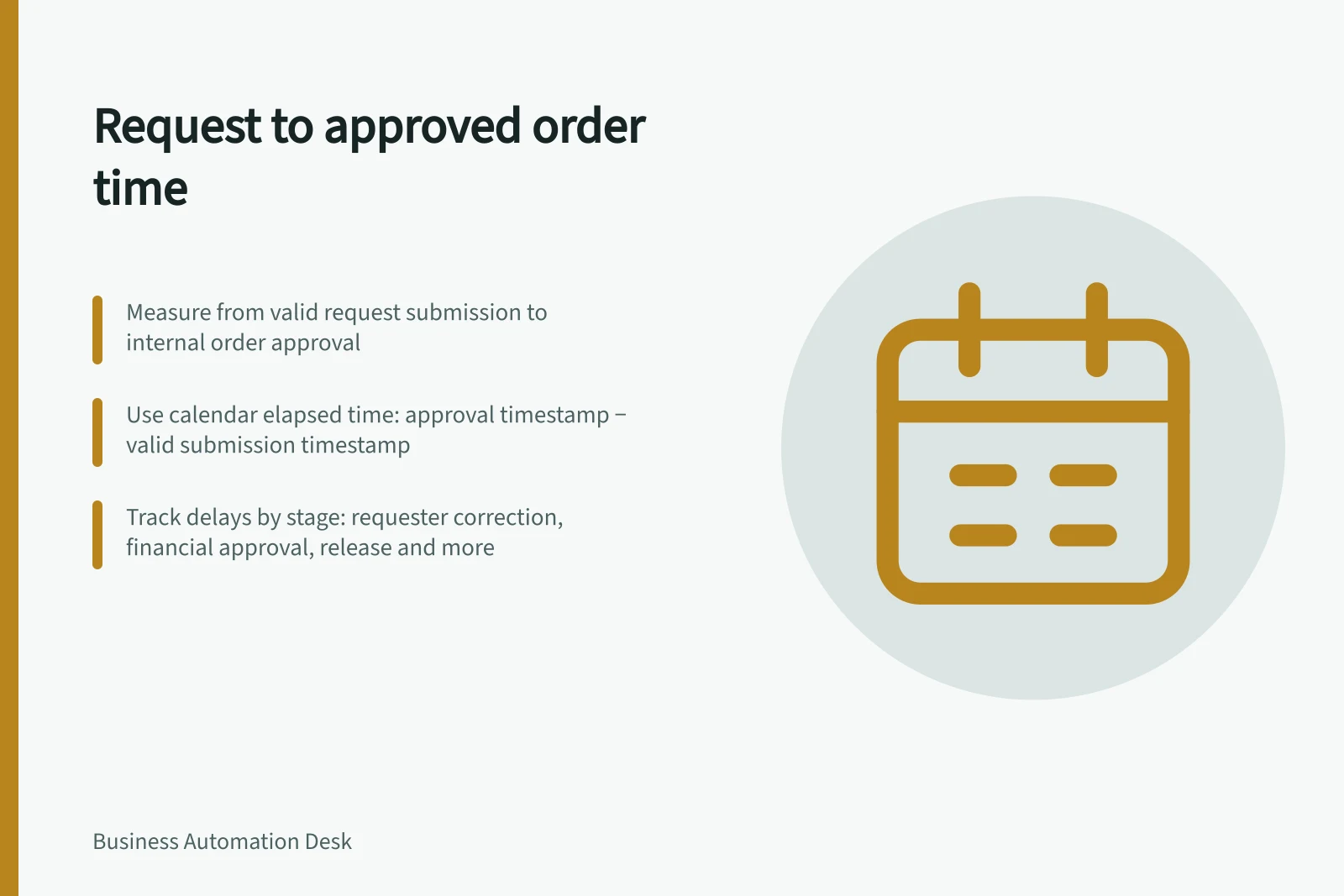
Calendar elapsed time = internal order-approval timestamp − valid request submission timestamp.
This measures the path after validation. Report initial-submission-to-validation time separately if intake quality matters. If business-hours time is useful, publish it as a separate measure with its working calendar and holiday treatment.
Key Metrics for Request-to-Approved Order Tracking
- Median elapsed time
- Reported in calendar days
- Completed cases count
- Total number of fulfilled requests
- Returned/denied/cancelled count
- Excluded from completion time calculation
Find the delay
Break the path into time awaiting requester correction, supplier information, specialist review, financial approval, order preparation and release. Record who had the next action at each transition. A long gap shows where to investigate; timestamps alone do not establish why it happened.
Show the median, a slower-case measure and the number of completed cases. Segment by category, value band, supplier status and standard versus exception route. Show returned, denied and cancelled requests with their counts rather than assigning them a fictional completion time.
Keep endpoints comparable
APQC lists a measure titled “Cycle time in days to issue a purchase order for goods and services (purchase requisition to purchase order)”.
The title uses “purchase requisition to purchase order”, while the measure defined here ends at internal order approval. Compare an external measure only when the unit, endpoints and inclusion rules match; no benchmark value is needed to monitor the local process.
Before relying on a report, trace representative event histories for a straightforward request, a returned request, a request split into two orders, a cancellation and an approved order not yet sent. Check the calculation and status against the events. Use the resulting measures to identify where comparable requests wait and whether changes reduce that wait.