Process Discovery
Robotic process automation
Understand what RPA bots do, how to assess a suitable task, when to consider integration and what a bounded pilot should check.
Robotic process automation (RPA) uses software to carry out defined actions in digital systems. A bot might read a field, enter information into another application and check the resulting record.
RPA suits work with clear rules and a way to verify the result. It cannot settle an unclear business decision, and a completed bot run does not necessarily mean the wider process has finished.
What a bot can drive
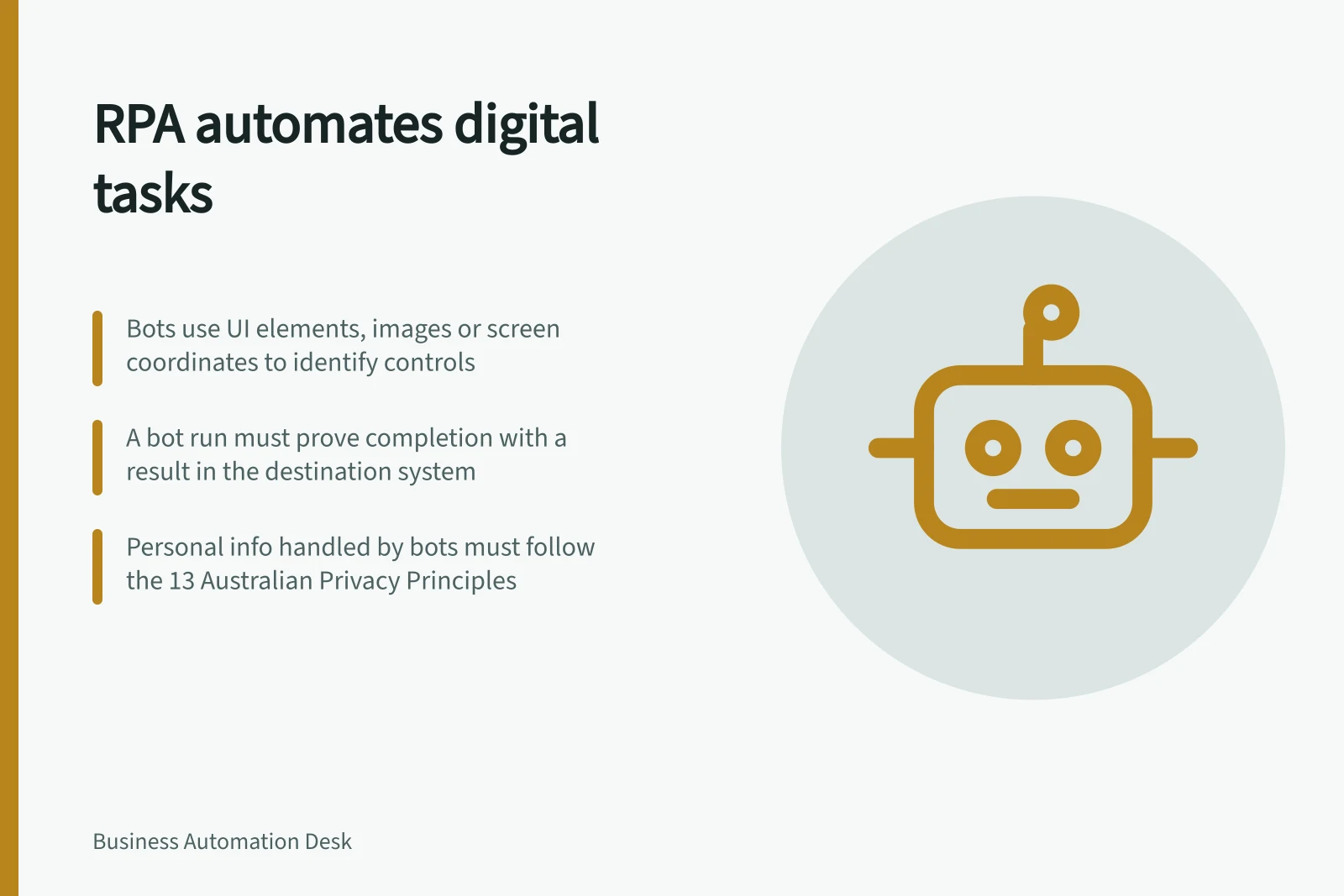
Desktop automation tools such as Power Automate offer prebuilt drag-and-drop actions and a recorder for building flows. Flows can interact with everyday tools such as email and Excel, and with modern or legacy applications, including terminal emulators. A bot can find controls through application UI elements, images or screen coordinates.
What an RPA bot does
A UI bot works through application screens, using fields, buttons and other controls. It may automate an action when a suitable integration is unavailable. RPA tools can also use connectors or APIs, so a workflow need not perform every step through a screen.
Consider a hypothetical team copying approved request details between systems. A bot could find the request, enter specified fields and check for the destination record. People still own the approval decision, source-data accuracy and rejected records.
An attended bot runs with a person involved in the task. An unattended bot runs without that supervision, subject to the platform and machine conditions it requires. Confirm the proposed arrangement before assuming a bot can run overnight or on a colleague’s workstation.
How a bot identifies controls
UI automation actions identify windows and their components through UI elements, which uniquely describe each component. A window being driven usually must be in the foreground, and the tool will bring it forward if it is not. Elements are captured by highlighting the component and pressing Ctrl + Left click.
A Get details of window action can extract a window's title, location or size. A Get details of a UI element in window action extracts data from a specific component inside a window. Captured elements are managed in the designer's UI elements pane and can also be added through an action's properties.
Assess a defined task
Start with the task’s trigger, input and required output. Staff should be able to state the rules, identify the necessary data and recognise a case that falls outside them. Check both process stability and application stability: a screen change can require bot changes even when the business rule stays the same.
| Question | What to establish |
|---|---|
| What starts the task? | The event or item that makes it eligible. |
| What may the bot decide? | Rules an authorised owner can state and verify. |
| What proves completion? | A result in the destination system, beyond a successful run status. |
| What falls outside the rule? | A route to someone who can resolve the case. |
| What may change? | Expected changes to the process, application or access. |
High volume alone is a weak reason to choose a bot task. A smaller, stable task may make a more useful first pilot than busy work completed in several undocumented ways.
Choose how the bot will access each system
Ask the application owner whether a supported API or connector can perform the required action and provide a usable result. If it can, compare that route with screen automation using the same permission, validation, error and support requirements.
If the action is available only through the interface, a UI bot may be reasonable when its use is authorised and it can identify the right screen state reliably.
The methods can be combined. A workflow might receive an item through a connector and use a UI step for an action the connector does not provide. At each handoff, define how an item is identified and how its status is checked. The technical comparison belongs to the separate RPA versus application integration article.
Personal information and privacy
Where a task moves personal information, the 13 Australian Privacy Principles under the Privacy Act 1988 apply to organisations and agencies covered by the Act, whether a person or a bot performs the step. The principles are technology neutral and cover governance, integrity and correction, and individual access rights.
The OAIC states that a breach is an interference with an individual's privacy and can lead to regulatory action and penalties.
Australian Privacy Principles (APPs) and RPA
- Number of APPs
- 13
- Applicable to bots?
- Yes – technology-neutral
- Breach consequence
- Regulatory action and penalties
- Key principles affected
- Governance, integrity, correction, individual access rights
Plan for exceptions and change
Define what happens when information is missing, a screen differs, access fails or an action may have partly completed. Hold an item with an uncertain result until its destination state is checked; repeating an entry could create a duplicate. Keep the business reference, attempted action, observed result and next owner visible.
Changes to an application or its environment can affect a UI bot; live scheduling, credentials, incident response and fallback belong in a separate operating plan.
Judge a bounded pilot
Choose one eligible case type and agree on its expected output. Include an ordinary case, invalid input and a failed destination action in the pilot plan. Compare each source item with the destination result, including any human correction.
Before expanding, look for correct outcomes, visible exceptions, manageable support work and no unexplained items. If the task or application is about to change, reconsider the pilot timing. A useful pilot supports a clear decision to continue, revise the task or choose another access method.
In this guide
- RPA versus application integrationCompare API or connector integration with a UI bot for the same transaction, including access, result checks, failures and mixed routes.
- Choosing a stable task for a bot pilotScreen a proposed RPA pilot task for clear rules, representative variations and expected process or application changes.
- Checking whether a user-interface bot is appropriateReview a proposed UI bot’s authority, screen reliability, runtime conditions, result checks and exception route before a pilot.